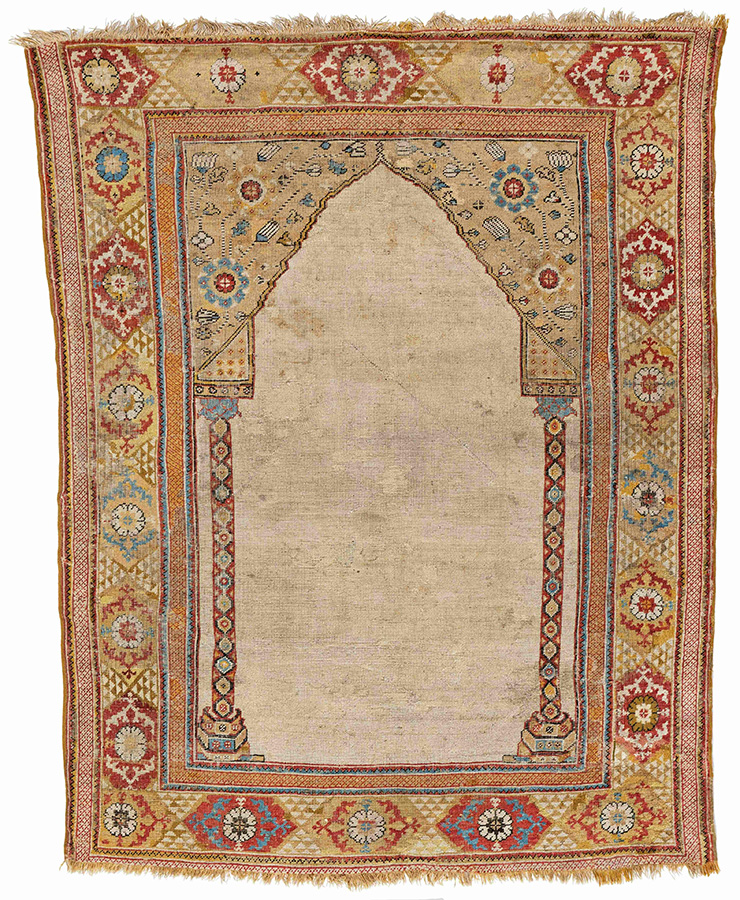
This rug was seen at Austria Auction Company in 2020.
Auction
description:
White-Ground Transylvanian Prayer Rug
163 x 129 cm
(5' 4" x 4' 3")
Turkey, early 17th century
Condition: good according
to age, low pile, both ends slightly incomplete, slightly stained,
selvages rebound, several old repairs
Warp: wool, weft: wool, pile:
wool
This carpet is one of the very rare white-ground prayer rugs
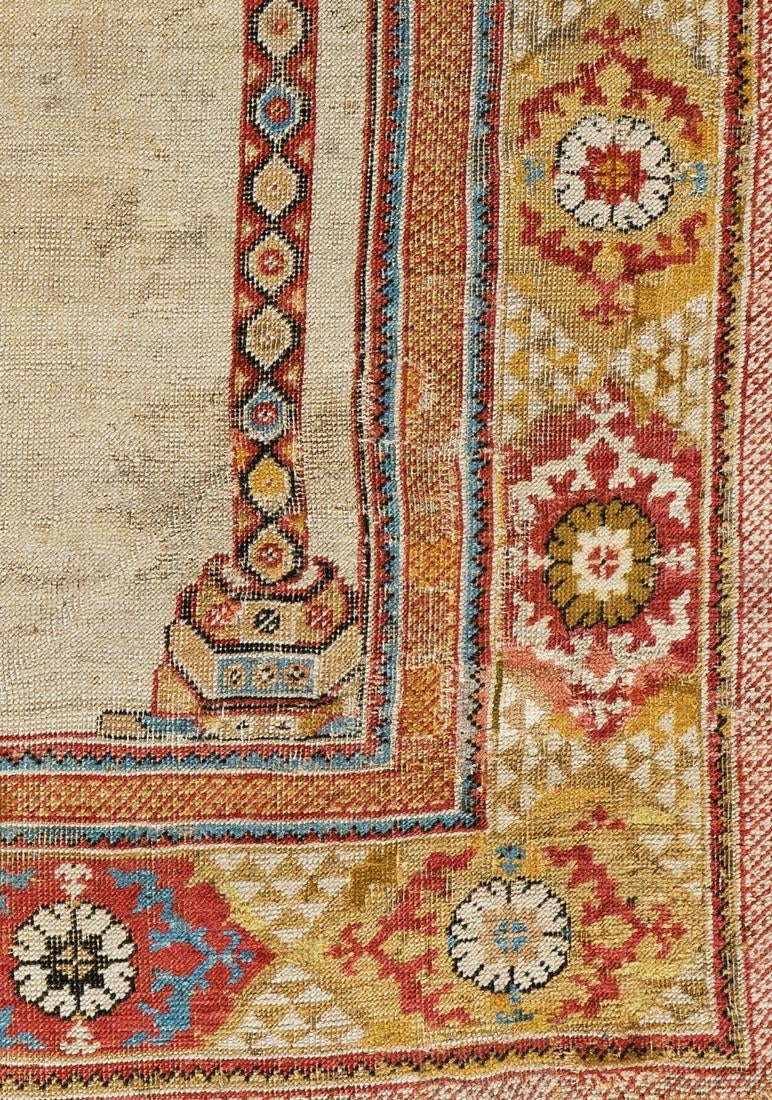
of Anatolia from the beginning of the 17th century. The border consists of
cartouches, which are separated by yellow or beige triangles can be to
create a mosaic-like pictorial effect.
The secondary border is drawn
as a lattice design in beige, red and yellow-brown. The colours are
usually double-mixed in themselves, whereby a special richness of colour
is achieved. The two columns of the carpet stand freely in the
white-ground prayer gable.
They are directly derived from the
Ottoman court carpets of the 16th century and thus plastically drawn that
a perspective effect is produced, which in such a form appears here for
the first time. For this reason a origin around 1600 seems very likely,
because later Column Ladiks show this drawing no more.
On the
chapter there are triangles which support the yellow-ground pediment,
which in turn is decorated with small tulips and carnations and freely
distributed rosette flowers. This drawing also has its direct model in the
Ottoman court carpets.
The completely unpatterned white prayer
field is divided into a larger one at the top right and several smaller
balancing lines, so-called lazy-lines.
A comparative piece with a
red prayer field and six narrow columns on similar, but no longer
perspectively drawn foundations can be found in the Black Church in
Kronstadt with the inventory number 126, described there as Transylvanian
prayer rug, Ladik region (see Gombos Karoly, Aszketak, Dervisek,
Imaszönyegek, Budapest 1984, cat. No. 51, for the gable field Kat. No. 3).
This carpet, of whose type allegedly only three pieces worldwide are
preserved, comes from royal Wittelsbach property.
|