
About the Antique Rugs of the Future Project

Sheep Breeds of Azerbaijan

Shearing,
Sorting, Washing, Carding, Spinning

"The advantages of handspun yarn to machine spun yarn"

Rediscovery of Ancient Natural Dyes
Our Natural Dyestuffs

Mordants

Difference between synthetically and naturally dyed rugs

Weaving and Finishing Steps

Galleries of ARFP Caucasian Azerbaijani Rugs


back to "Antique Ottoman "Transylvanian" rugs" main page


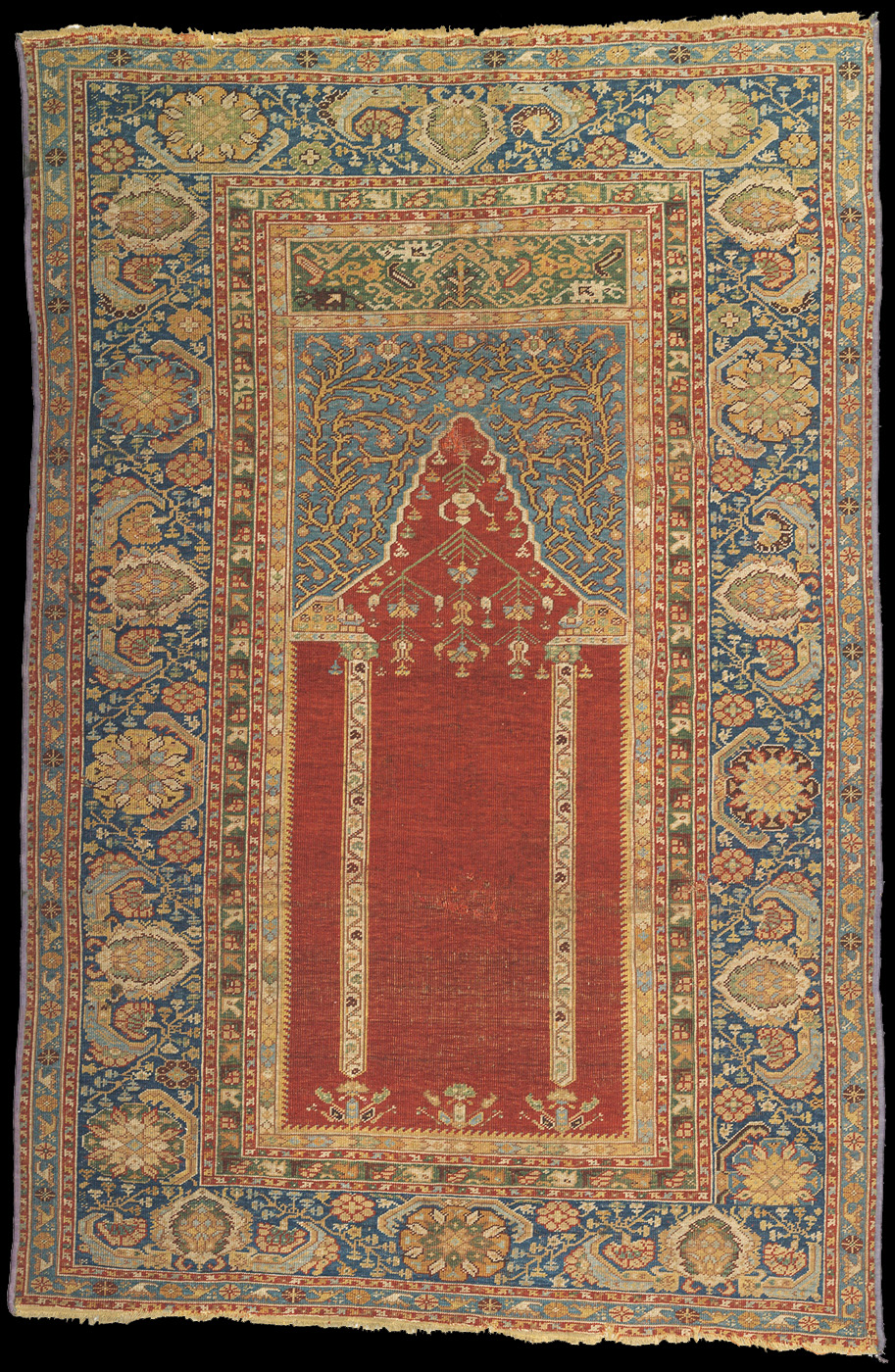
Western Anatolian Turkish Prayer rug, "Transylvanian type", early 18th century, possibly Kula region. Lehman Collection, currently The Metropolitan Museum of Art, New York


Medium: Wool (warp, weft and pile); symmetrically knotted pile

Dimensions: Length: 2 m x Width: 1.3 m.

Credit Line: Robert Lehman Collection, 1975
Accession Number: 1975.1.2454
This artwork is not on display

Provenance: Joseph V. McMullan , New York (by 1965–d. 1973)


Catalogue Entry
This rug has a niche supported by two columns, a portable equivalent of the element indicating the direction of Mecca for prayer in a mosque or other type of building. The columns are quasi-architectural in nature, preserving the domed aspects of the capitals, and thus recalling the dozen or so earlier Ottoman works with clearly delineated edificial references. The border pattern, with alternating palmettes and rosettes flanked by paired curved leaves, also resembles classical Ottoman prototypes. In other respects, however, features of the niche show signs of lapsing into decorative convention: the columns themselves have been reduced to patterned bands now supported by flowers instead of proper bases. Note also the inverted ewer at the apex of the niche, a common allusion to a vessel for the ritual ablution required before prayer. Like most Turkish prayer rugs, this one was woven with the pattern upside down. This rug is called Transylvanian because many works of the type, probably from Kula, and other rugs from Gordes and Demirci, all in the Manisa Province of Anatolia, survive in the collections of eastern Europe, especially in the churches of Transylvania. They were considered at one time to be of local manufacture, hence the name, but this misconception has been corrected. Several similar works remain, including one in the Evangelical Church of Sebes (Mühlbach), which has two columns floating upon inverted ewers and a mosque lamp suspended in its niche.